Complete Guide to IB English Paper 1: How to Get a Level 7, According to IB
Online IB English Tutors. ROOTS Academy offers an exam-oriented, step-by-step approach to guide students in mastering everything they need to achieve a Level 7 at IB English Language and Literature. Contact us at rootsacademy.hk@gmail.com to learn more.
Executive Summary: In gist, each criterion can be broken down into the following components —
Criterion A (Understanding & Interpretation): To score full marks for Criterion A (5 marks), you not only have to briefly summarise your literal understanding of the text in the introduction of your essay (i.e., what the author is explicitly and literally saying), but also analyze in depth the implications and the subtleties beyond the literal words (i.e., what the author is really trying to say). These analyses must be sufficiently supported by an ample and effective use of references (be it direct quotes for word-heavy texts or a summary/description of visual elements for image-heavy texts) that logically support and connect with your interpretation of authorial intention.
Criterion B (Analysis & Evaluation): To score full marks for Criterion B (5 marks), you need to be able to accurately identify the author’s use of textual and visual devices as specifically as you can, and also evaluate their effectiveness in conveying and articulating the implications and subtleties within the text.
Criterion C (Coherence, Focus & Organization): To score full marks for Criterion C (5 marks), you need to address the guiding question that accompanies each text (remember, your Paper 1 is defined by the IB as a “guided analysis”, not an essay!), preferably using the language of the guiding question (break down the question into key words and integrate them into your thesis statement and topic sentences). In addition, students should aspire to move fluidly between ideas — and this applies both between one paragraph to the next as well as within the same paragraph. This can be demonstrated through strong thesis statements, topic sentences, and concluding sentences that combine representative literary devices with the student’s interpretation of the implications within the text.
Criterion D (Language): To score full marks for Criterion D (5 marks), you should aspire to maintain a consistently academic and formal tone throughout the essay, deploy clear and sophisticated vocabulary, ensure that you write with utmost grammatical accuracy, use a variety of complex sentence structures and constructions, and ensure that you use the right terms to describe the right literary devices (i.e., accurate terminology).
About the Paper 1
Paper 1 consists of two previously unseen non-literary passages from two different text types, each accompanied by a guiding question.
Paper 1 is assessed on four criteria: Criterion A (Understanding & Interpretation), Criterion B (Analysis & Evaluation), Criterion C (Coherence, Focus and Organization), and Criterion D (Language). Each criterion is marked out of 5 and the maximum marks an SL student is 20 marks while the maximum marks a HL student can get is 40 marks.
In this article, we will break ldown each criterion so students have a better sense of what IB actually expects from a level 7 answer. It is very important that students are able to internalize very early on what IB actually expects from them, and be able to create a mental checklist they can refer to whenever they are doing past papers or writing the actual exams.
“... in IB, it is not enough to be able to summarize what the author is literally saying, you also need to analyse, and what this means is understanding the implications and subtleties beyond the literal words that you see. ”
Criterion A — Understanding & Interpretations (5 marks)
What IB says
Guiding Question(s): How well does the candidate demonstrate an understanding of the text and draw reasoned conclusions from implications in it? How well are ideas supported by references to the text?
Level 5 descriptor: “The response demonstrates a thorough and perceptive understanding of the literal meaning of the text. There is a convincing and insightful interpretation of larger implications and subtleties of the text. References to the text are well-chosen and effectively support the candidate’s ideas.”
What IB means
In practical terms, Criterion A can be broken down into three components:
Being able to understand and summarize the literal meaning of the text;
Being able to understand and analyze the implications and subtleties within the text; and
Both an ample and effective use of references.
Component 1 — Literal meaning / Primary Purpose
The first of the three components to Criterion A is literal meaning, and this refers to the primary purpose of the text. In simpler words, literal meaning is what the author is literally and explicitly trying to say. This is merely an exercise of comprehension that probably doesn’t require much deliberation or critical thinking, and a short summary of the text in the introduction would generally suffice.
Component 2 — Implications / Secondary Purpose
What’s tricky about paper 1, however, is to be able to discern and analyse the implications beyond the literal meaning of the text — in IB, it is not enough to be able to summarize what the author is literally saying, you also need to analyse, and what this means is understanding the implications and subtleties beyond the literal words that you see.
Tip 1 — Importance of context: Often times, IB will give you some contextual clues to help you identify what the author is trying to imply. IB often likes texts that have very strong contextual elements and what they like to see from students is an ability to connect these contextual elements with how they “shape meaning” in the text. Sometimes, these contextual clues may appear in the footnotes (remember to read the text thoroughly) or even the description of the text. These clues may give you some context as to who the author is, when and where the text was published and what kind of historical / political / social context in which the text was published. In turn, you must think about and analyze how these contextual elements play into the text itself — how does the context of the passage influence or affect what the author has to say? This is not something that IB will explicitly spell out for you, and it’s up to you (through practice) to be able to identify these nuggets of information and connect them with what the author is really trying to say.
Tip 2 — Be explicit and use “interpretative” language: A helpful, practical tip with Paper 1 is to use a lot of “interpretative language” to show the examiners, explicitly, that you are indeed conducting an interpretative exercise. Sentence stems like “Through [language or visual devices identified], the author implies / suggests / insinuates that…” or “What the author is trying to imply is…” are helpful.
Component 3 — References
The use of references is explicitly stated in the criterion as a crucial component of Criterion A — without it, you will not be able to get full marks. Though it appears straightforward, mere references to the text without thought will not get you there, and there are two things students should bear in mind — references need to be both ample (i.e., scattered frequently and consistently throughout your analysis) and effective.
In terms of choosing effective references, what IB expects to see are references that are both “well-chosen” and “effectively support the text”, and what this requires is a careful deliberation of whether the references chosen logically support your argument and interpretation of the implications within the text. Generally, this can be determined by whether the references you chose directly represent the authorial choices that you have identified and the literary devices (textual or visual) that the author has deployed.
Tip 3 — embedding references: one important skill that students should aim to develop over IB is the ability to seamlessly embed and integrate references or quotes within the analysis. Sometimes (and often times), it is better not to copy complete sentences or quotes from the text but to integrate parts of it into your analysis, so as to give your writing better flow and enhancing both organization (Criterion C) and language (Criterion D).
Learn more about understanding implications and how to fully master Criterion A in our blog article: Breaking Down the Criteria — Paper 1 Criterion A

Advertisements are one of the most popular text types for IB English Lang&Lit Paper 1!
Criterion B — Analysis & Evaluation (5 marks)
What IB says
Guiding question(s): To what extent does the candidate analyse and evaluate how textual features and/or authorial choices shape meaning?
Level 5 descriptor: “The response demonstrates an insightful and convincing analysis of textual features and/or authorial choices. There is a very good evaluation of how such features and/or choices shape meaning.”
What IB means
In practical terms, Criterion B can be broken down into two components:
Accurate and specific identification of visual and literary devices; and
The evaluation of the effectiveness of visual and literary devices.
Component 1 — Identification of techniques
Criterion B hinges heavily on students’ visual and language literacy — i.e., their knowledge of literary devices and how well they are able to identify them in the text. Of course, this takes practice, and over the course of IB, students should aim to develop and acquire a vast repertoire of literary devices (both textual and visual). This should encompass not only simple ones like simile or pathos but also more advanced ones like anadiplosis (where the last word of one sentence/clause is repeated in the first word of the next sentence/clause) or litotes (an ironic understatement), just to name a few.
Tip 1 — The importance of specificity: one thing students should all bear in mind with regards to Criterion B and the identification of techniques is that you must be as specific as you can when pinpointing techniques, for the level of specificity directly affects the quality of your analysis and evaluation.
For example, it’s not enough to say that the author uses “imagery”, you must specify what kind of imagery is used (is it visual/auditory/olfactory/kinesthetic/tactile/gustatory imagery?). This also applies to a myriad of other techniques, like alliteration, where, depending on the sound being repeated, can be identified as fricative / plosive / sibilance / dental / guttural / liquid. Here, each variation creates a different mood and may carry different connotations, which may in term shape meaning and affect readers’ receptions of the text differently. Thus, it is imperative that students try to be as specific as they can when identifying techniques, as it may directly influence their interpretation of authorial choices and the quality of their analysis.
Component 2 — Evaluation of techniques
Likewise, when we are evaluating the use of techniques, we also have to be very specific – we need to think about what their function is within the text and how they've been used, and evaluate how this function directly influences the meaning and our interpretation of the text. Again, specificity is crucial – we always have to think about why the author uses a specific technique to convey a specific message, and how does it impact our overall understanding of the text.
Tip 2 — readers’ effect and the meaning of “shape meaning”: One crucial term that appears throughout the IB English curricula (and sometimes in guiding questions of papers as well) is the term “shape meaning”. What IB essentially means here, is for students to think about and analyse readers’ effect. We need to put ourselves in the readers’ shoes and think about the text in terms of (1) how it makes the readers feel, (2) what the readers might think, and (3) what the readers might do.
Tip 3 — intended audience: Of course, above and before everything, students must first be able to accurately identify who the author’s intended target audience is, for the analysis directly hinges on what kind of impression the text might make on that specific group of audience. On top of that, students should also think about whether there are any implications behind the author’s specific choice of audience and how their authorial choices reflect that. (Tip within the tip: be specific when identifying the text’s intended audience — something like "the American people” simply won’t cut it! Try to hone in a specific demographic — when it comes to Paper 1, you can never be too specific! A good example with sufficient specificity can look something like: “young Australian men who are educated and tech-savvy”).
“... above and before everything else, students must first be able to accurately identify who the author’s intended target audience is, for the analysis directly hinges on what kind of impression the text might make on that specific group of audience. On top of that, students should also think about whether there are any implications behind the author’s specific choice of audience and how their authorial choices reflect that.”
Criterion C — Focus & Organization (5 marks)
What IB says
Guiding question(s): How well organized, coherent and focused is the presentation of ideas?
Level 5 descriptor: “The presentation of ideas is effectively organized and coherent. The analysis is well focused.”
What IB means
Although the wording of this criterion is more vague when compared to the other criteria, IB’s definition of a “focused” analysis generally boils down to two components:
How well the student answers the guiding question using the language of the guiding question; and
How well the student is able to move fluidly between ideas (both between paragraphs and within the same paragraph).
Component 1 — Answering the Guiding Question
In the description of Paper 1 in the curricula (2021 course assessment), IB states: “Paper 1 contains two previously unseen non-literary passages. Students write a guided analysis on both of these passages. A guided analysis in this context refers to an exploration of the passage supported by a guiding question which asks the students to consider a technical or formal aspect of the passage.”
So based on the language of the curricula, Paper 1 is technically referred to as a “guided analysis” instead of an essay. Since IB defines guided analysis as an exploration of the guiding question, the key to writing a “focused” analysis (and scoring well on Criterion C) is therefore to be able answer and address the guiding question. Note, however, the guiding question is there to “guide” students — while it is imperative to address it (without doing so, they won’t be able to get full marks in this criterion), students should not feel limited by it and instead aim to go beyond it in their analyses.
One way to show the examiners that you are answering the guiding question (and that your response is indeed “focused”) is by integrating the language of the guiding question throughout the essay. To do this, before writing, it is helpful for students to break down the key terms of the guiding question and try to integrate them frequently and consistently throughout the essay (especially in the introduction, thesis statement, and the opening and concluding statements of each paragraph).
Component 2 — Moving Fluidly Between Ideas
Another important component of Criterion C is how well students are able to move fluidly between ideas. An easy way to achieve this is by cultivating the skill to write strong thesis statements and topic sentences that combine both literary devices and the student’s interpretation of authorial intention (i.e., implications within the text). And not only should the student aspire to move fluidly between paragraphs, they should aspire to do the same within paragraphs, making sure that ideas are presented in an organized, coherent, and logical way.
Over the course of IB, students should aim to develop the skill to quickly but effectively produce concise and analytical essay plans that comprise of an introduction (thesis statement) and topic sentences of all body paragraphs.
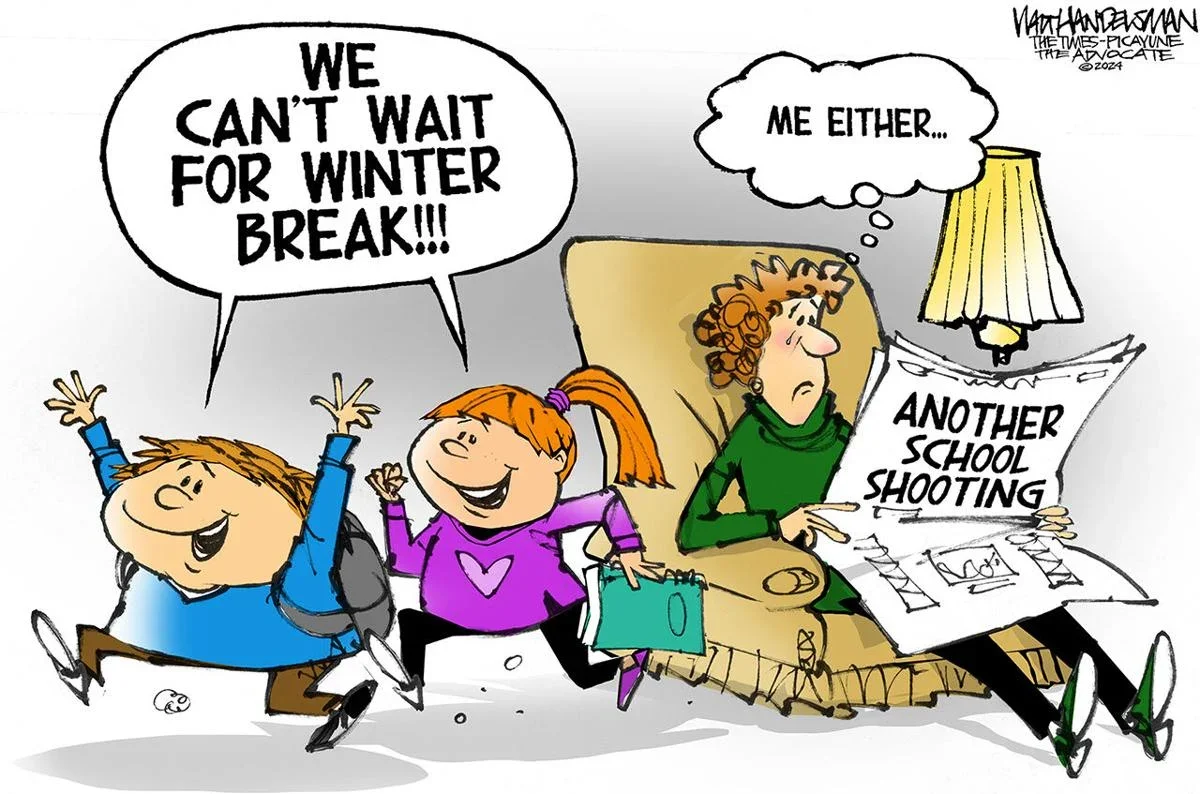
Political cartoons are another popular choice of text type for Paper 1.
Criterion D — Language (5 marks)
What IB says
Guiding question(s): How clear, varied and accurate is the language? How appropriate is the choice of register and style? (“Register” refers, in this context, to the candidate’s use of elements such as vocabulary, tone, sentence structure and terminology appropriate to the analysis).
Level 5 descriptor: “Language is very clear, effective, carefully chosen and precise, with a high degree of accuracy in grammar, vocabulary and sentence construction; register and style are effective and appropriate to the task.”
What IB means
In contrast with the other criteria where the ability to maximise your scores can be more easily learnt and acquired throughout IB, much of Criterion D hinges on your inherent English writing skills — put simply, it is not something that you can develop or “learn” over a short period time and normally takes years to build up and cultivate. However, that being said, with persistence and discipline, it is definitely something that students can work on (the key here is practice, practice and practice!).
Criterion D is much more broad when compared to the other criteria and encompasses a wide range of elements, including a formal tone, sophisticated vocabulary, grammatical accuracy, complex sentence constructions, and accurate terminology.
Tone: try to maintain a consistently formal and academic tone throughout the essay and avoid using colloquial and conversational language like “I think”, “perhaps”, “maybe”, “I guess” or contractions like “you’re”, “I’ve”, “could’ve”, etc.
Vocabulary: it is helpful for students to put in consistent effort into expanding their vocabulary throughout the course of IB. However, the priority should always be conciseness and clarity — instead of using overly complex words that you do not completely understand, students should always prioritise on how well they are able to articulate their ideas to the reader. Students are not graded based on how “big” their choice of words are or how complex their sentence constructions are, but how well they are able to utilise language to articulate their ideas.
Grammar: Students must remember to use literary present (i.e., present tense) consistently throughout their essays. This applies not only to Paper 1 but also to Paper 2 and your Higher Level essays. When students are in a panicked rush during exams, they often look past grammatical accuracy which may in turn cost them marks in Criterion D. Students must make sure to leave enough time to proof read their work before the exams end, and again, it is crucial for them to practice how to write under the constraint of time well ahead of their exams.
Sentence Structure & Construction: it is important for students to use complex sentence structures (where one independent clause is combined with one or more dependent clauses using a subordinating conjunction) to add detail and sophistication to their writing. On the other hand, they should avoid run-on and overly long sentences that might hinder their clarity or conciseness.
Terminology: in the context of Paper 1, terminology refers to the accuracy of the literary devices identified (i.e., whether the student has identified the right technique and used the right term to describe it). Therefore, this is highly linked with Criterion B.